
A cube is not a cube
Over the last year we bred approximately 90 genotypes of Psilocybe cubensis using knowledge of the genotype at the psilocybin locus in different haplotypes from our library. Our hypothesis was that different genotypes and heterozygous alleles at the psilocybin locus would alter the profile of tryptamines among our bred genotypes. Put simply, we expected to reject a hypothesis 'a cube is a cube'.
We crossed four Australian haplotypes against three haplotypes each from different cultivars that had different alleles at the psilocybin locus. This experimental design had three biological replicates for each heterozygous genotype at the psilocybin locus. We screened these genotypes for their landscape of tryptamines courtesy of support from BioPlatforms Australia.
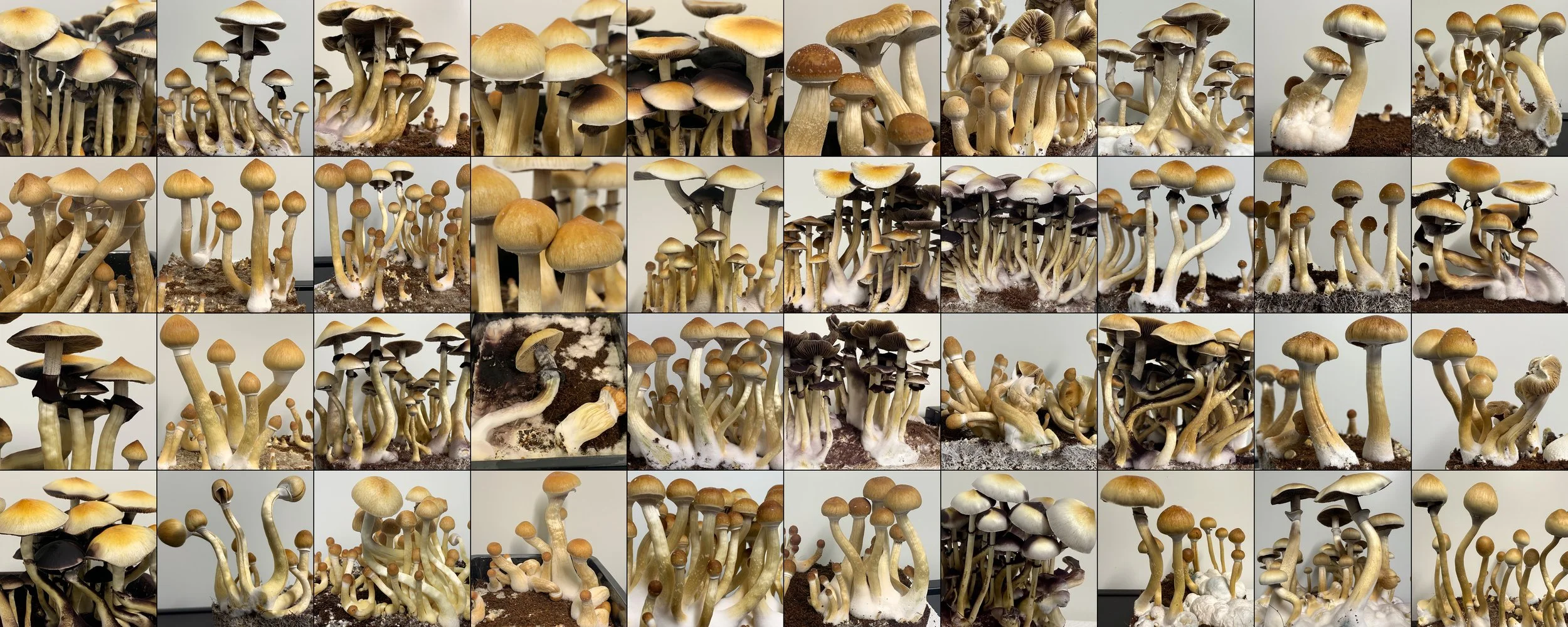
Crossing matrix of genotypes bred for heterozygosity at the psilocybin locus. Each row is the same Australian haplotype (Sunshine Coast, North Queensland, SE Queensland. The two bottom rows come from the same parent, but differ in their alleles that control mating compatibility. Each column is the same haplotype from a cultivar of Psilocybe cubensis.
Our metabolomic data came back at the end of last year and we will share it with the community in a scientific paper. We're waiting on additional genomes to complete our study, but in the meantime, here are some of what we saw with the metabolomic data.
Before we get to the results, lets be clear about what we have yet to understand as a scientific community:
- We have more knowledge to gain on how dikaryotic fungi regulate expression of heterozygous alleles. Think of two nuclei with different genetic instructions that exist in a cytoplasm with finite resources. Which nucleus will take priority to express their alleles? Are some nuclei synergistic and others competitors?
- We do not understand the pharmacology behind how tryptamines activate G protein-coupled receptors (such as serotonin receptors). These receptors trigger cellular cascades, some ligands have better binding affinity (receptor occupancy) and require less to start a cellular cascade (dissociation equilibrium). Specifically, the differences in cellular pathways expressed between psilocin and norpsilocin binding to serotonin receptors is not yet understood and is complex beyond baeocystin/norpsilocin having a lower concentration in mushrooms.
- How do we define consciousness? Near-impossible to describe. Now, how do we describe an altered state of consciousness? There are few absolute certainties, especially in biology. To speak with certainty rather than frame ideas as hypotheses may indicate a highly complex topic is oversimplified. Psychedelic experiences are complex beyond one molecule binding to one receptor, and it is a disservice to dismiss the landscape of tryptamines in magic mushrooms as non-hallucinogenic and unessential for a psychedelic experience.
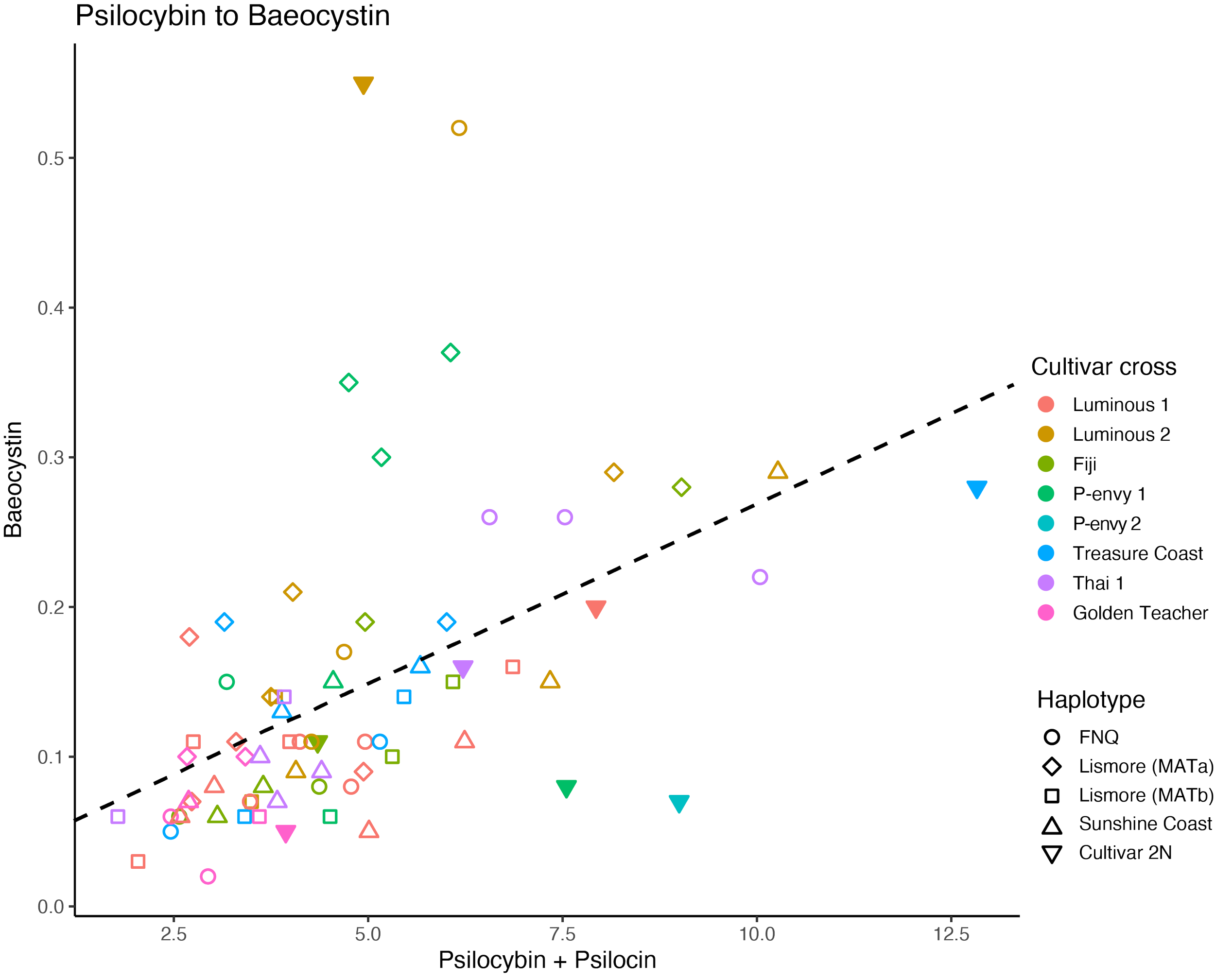
Scatter plot of ratio of psilocybin to baeocystin for the genotypes screened so far. Dashed line is a line of best fit, and we would expect the ratio to be consistent to support a hypothesis ‘a cube is a cube’.
Our metabolomic results are not surprising to anyone with an understanding of genetics. Different alleles drive different phenotypes in all biodiversity, whether flavour profiles in apples to banding patterns in zebras.
From our data, we can reject a hypothesis 'a cube is a cube' and support that genotype at the psilocybin locus impacts expression of tryptamines. If cubes were all the same, we would expect their tryptamine ratio to cluster along a line-of-best-fit. Rather, different genotypes can have low or high concentrations of baeocystin relative to their concentration of psilocybin. We bred genotypes with 6-fold differences in the concentration of baeocystin compared to genotypes that are weak producers of baeocystin.
The Penis envy genotype at the psilocybin locus produces low ratios of baeocystin (supported by two cultivars with this genotype). Has baeocystin intentionally been selected against in Penis envy, or is this an accidental outcome from breeding for aesthetic?
There is a 'sweet spot' of baeocystin to psilocybin. There is strong evidence that baeocystin is under selection in magic mushrooms (exemplified by the recent work on Inocybe by Schäfer et al. (2025)). A number of our bred genotypes wound up producing baeocystin to psilocybin at a similar ratio, even when crossed against haplotypes that had low baeocystin when homozygous.
We cannot predict what will happen when different alleles are mixed. Our biological replicates are often evidence that the outcome of crosses (with the same genotype) give a similar ratio. But, it is unpredictable how a dikaryon will behave based on their outcomes in other genotypes.
Degradation is an issue. Our samples were stored for up to two months before their tryptamines were extracted. Samples stored for eight months had no detectable psilocybin. Does baeocystin degrade at the same rate as psilocybin? Even with degradation, and even with different rates of degradation among tryptamines, our data are clear that different genotypes of cubes produce different tryptamine profiles.
Our data, combined with the following findings from the scientific community, build a picture that we expect psychedelic experiences to differ from different genotypes of mushroom.
- Baeocystin is an endpoint rather than a byproduct in biosynthesis of psilocybin (baeocystin is under selection)
- 4-hydroxytryptamine and norpsilocin are competitive agonists at serotonin receptors
- Norpsilocin has antidepressant properties in rodents
- Balancing selection maintains allelic diversity in the biosynthetic genes for psilocybin in natural populations of magic mushrooms
- Biological innovation of psilocybin by magic mushrooms in different ecological niches for >60 million years will have honed metabolite profiles for success in different niches
- Magic mushrooms outperform synthesised psilocybin in terms of longevity of actions
The effects of magic mushrooms on humans are a joyful evolutionary coincidence that culminate from 60 million years manipulating serotonin receptors that control mood, appetite, and photoreception in animals that ate mushrooms over an evolutionary scale. Quite the opposite of other metabolites in mushrooms fatal to humans but that leave their other natural symbionts unscathed.
Challenge statements that simplify psychedelic experiences on magic mushrooms (such as ‘a cube is a cube’, or ‘dose, set and setting are the only factors in an experience’). The scientific narrative demonstrates the interaction between humans and magic mushrooms is complex beyond our understanding for the short term.
